

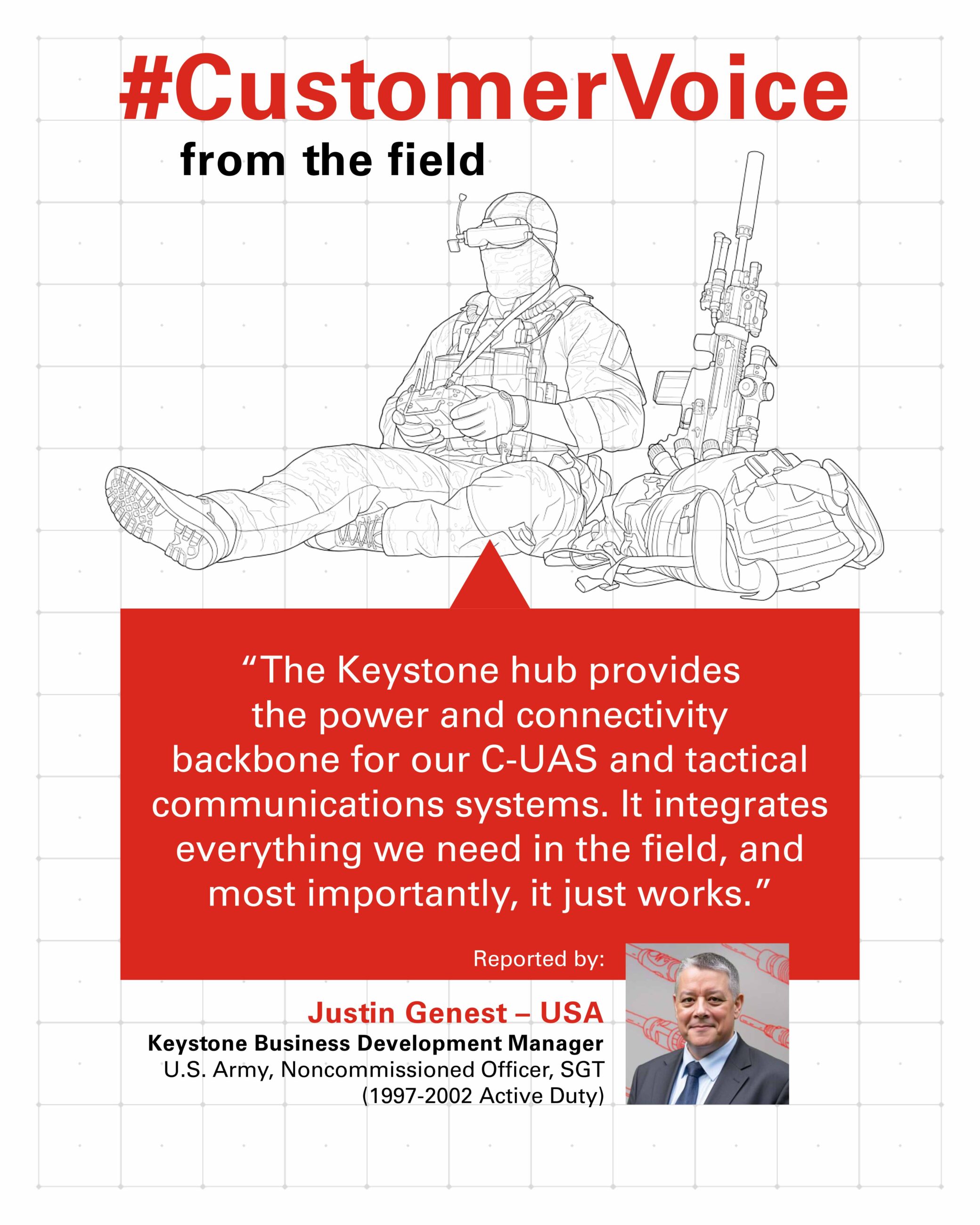
“The Keystone hub provides the power and connectivity backbone for our C-UAS and tactical communications systems. It integrates everything we need in the field, and most importantly, it just works.” – Field feedback shared with Justin Genest, KEYSTONE Business Development Manager, and former U.S. Army Noncommissioned Officer (SGT, 1997-2002 Active Duty)
Customer voice: how KEYSTONE data and power hubs simplify edge connectivity for NGC2 – the drone operations use case
July 16, 2026 · 4 min readThat single piece of feedback from military personnel, shared directly with our KEYSTONE team, sums up why hubs matter at the tactical edge.
Take the example of drone operators, who are among the most connectivity-reliant soldiers on the battlefield. Whether physically deployed alongside the combat unit, working from a forward command post, or piloting remotely from thousands of kilometers away, they juggle controllers, video feeds, batteries and radios in real time – often under pressure, if not always on the move.
So when field feedback like this lands on a plug-and-play power and data hub, it’s worth asking why. The answer lies in a bigger shift reshaping how soldiers connect: Next Generation Command and Control, or NGC2.
NGC2 turns every soldier into a digital node
Under the NGC2 paradigm, soldiers must be fully connected, acting as digital nodes within a secure, interoperable network linking individuals, squads and command centers. That’s a profound change from traditional battlefield communication. It means the dismounted soldier – and especially the drone pilot managing a UAS controller, video downlink and situational-awareness devices simultaneously – is no longer just a communications endpoint. They are an active participant in a live, data-driven network that command relies on for faster, better decisions.
This shift comes with challenges. As Fischer Connectors’ technical analysis of the connectivity challenge behind NGC2 makes clear, soldiers at the tactical edge face two compounding sources of complexity under this new paradigm: dramatically higher volumes of data moving across the network, and the arrival of AI and analytics tools that depend on that data reaching the network reliably and in real time.
Wearable cameras, environmental sensors, target designators and drone controllers can all feed NGC2’s analysis capabilities – but only if the edge soldier can move that data into the network simply and without added burden.
Layer onto that the physical reality of carrying multiple devices, each historically demanding its own power supply and its own cabling, and it’s easy to see how a dismounted soldier’s kit can quickly become unmanageable.
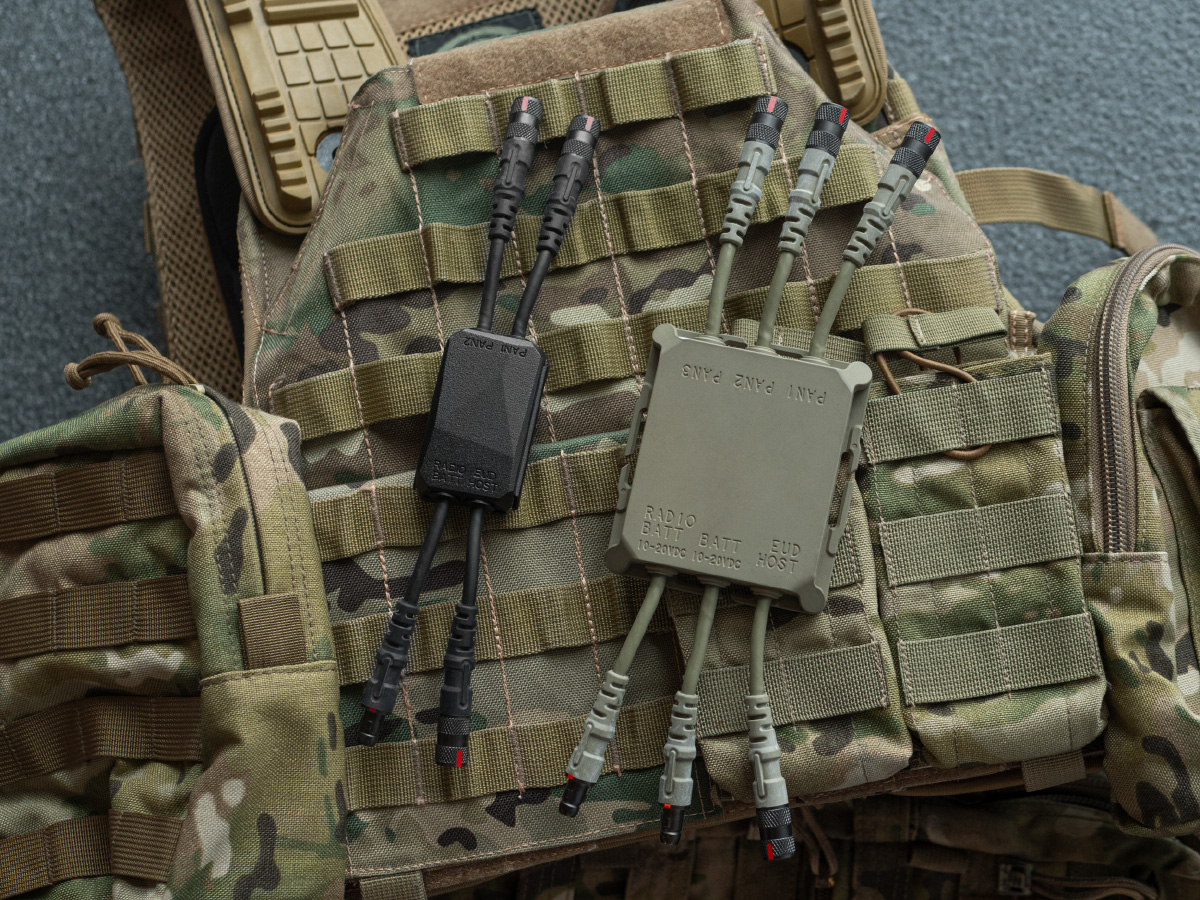
KEYSTONE: built for easy connectivity and efficient data and power management
This is precisely the problem Fischer KEYSTONE hubs were designed to solve. Designed specifically for dismounted operations, Fischer KEYSTONE 4- and 6-port hubs enable the connection and powering of multiple devices, efficient data management, and seamless integration of equipment from multiple vendors – all in a rugged, field-proven form factor.
For a drone pilot, that translates into something very concrete: one hub, one battery source, and standard connectors that let a UAS controller, RF detector, handheld jammer, radio and other wearable devices share power and data without a tangle of proprietary cables or device-specific power packs.
There’s no need for specialized training or technical configuration to get equipment talking to the network – connecting the gear is enough. It’s this kind of everyday reliability that produces feedback like the comment above: a hub that simply keeps pace with soldiers in the field.
That simplicity also extends to interoperability. NGC2 is built to connect Army systems with those of other services and coalition partners, and at the tactical edge, KEYSTONE lets non-Army users and multi-vendor equipment join the network the same way – through a simple physical connection, with no specialized skills required.
Providing the backbone for NGC2 integration
The success of NGC2 depends on more than advanced sensors, drones and software. It requires an underlying connectivity infrastructure capable of moving data and power reliably across the tactical edge.
Fischer Connectors has positioned KEYSTONE as a practical answer to this challenge.
As the Army pushes toward an environment where soldiers exchange far greater volumes of data and lean more heavily on AI-driven analysis, the equipment that connects soldiers to that network has to disappear into the background rather than add to their workload.
By reducing complexity, simplifying device integration and supporting both current and future digital battlefield systems, the rugged, modular and mission-ready KEYSTONE hubs are proving that a field-tested connectivity solution can do exactly that – enabling dismounted soldiers and drone operators focus on mission execution rather than technology management.
More on Fischer KEYSTONE:
- Product page: Fischer KEYSTONE™ Series
- News of April 17, 2025: Fischer KEYSTONE Tactical Hub enables plug-and-play connectivity with key soldier devices
More on NGC2:
- Tech Insights paper, April 2026: The Connectivity Challenge – Fischer KEYSTONE Hubs: Simple Edge Connectivity for Next Generation Command and Control
This may be of interest to you
Next news
Customer voice: delivering swiftly to medical device manufacturers – the surgical robotics use case
July 22, 2026 · 4 min read